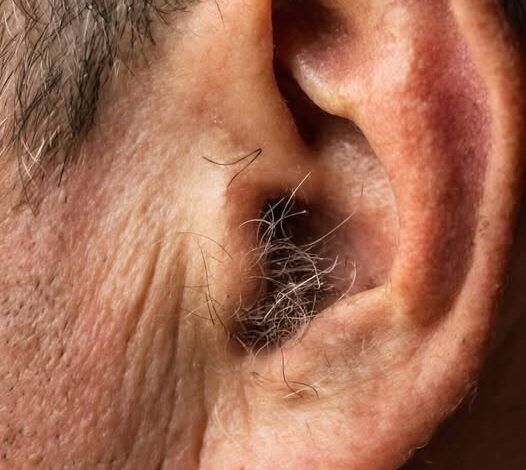
In the quiet, domestic theater of our morning grooming rituals, the concept of “enough” is often defined by the precision of the mirror. For many, the discovery of a long, wiry hair protruding from the ear canal isn’t just a minor cosmetic surprise; it feels like a “forensic” marker of a sudden, unwanted shift into a new life stage. We tend to view our bodies as static entities, but the “unvarnished truth” is that we are living archives of biological change. When hair begins to sprout in places it never inhabited during our youth—the ears, the nose, or the crest of an eyebrow—it triggers a “clumsy” wave of “unexplained anxiety.” Many immediately worry that these rogue strands are symptoms of an underlying illness, a “private horror” of hormonal decline, or a clinical red flag for poor circulation.
The reality, however, is a “shielded” truth that is far simpler and much more “majestic” than any medical myth. Ear hair is not a sign of disease; it is the natural result of aging, hormones, genetics, and the relentless work of time progressing quietly inside the human body over many decades. It is a “living archive” of how our hair follicles respond to the shifting tides of androgens, specifically testosterone and its potent byproduct, dihydrotestosterone (DHT). While we often think of these as “male hormones,” the radical transparency of biology shows that they exist in everyone, dictating growth patterns that evolve as the decades pass.
As we move through the “hidden journey” of our fifties and sixties, our bodies do not change uniformly. While the hair on the scalp may begin a “deadly fall” toward thinning or recession, the follicles in the ears and nose often receive a “clumsy” new set of instructions. This happens because hair follicles are not identical; they are highly specialized “forensic” sensors that react differently to the same hormones depending on their location. In the ears, these follicles often become more sensitive to androgens over time, extending their growth phase and producing thicker, more visible “terminal” hairs. For men, this is a common hallmark of midlife, while women may notice a similar “private reckoning” after menopause, when the “shielded” protection of estrogen declines and the hormonal balance tilts toward a relative androgen dominance.
Genetics act as the “legal wall” that determines the density and pattern of this growth. If the men in your lineage sported prominent ear hair, it is highly likely that your own “living archive” will follow suit. This isn’t a flaw or a “clumsy” error in your DNA; it is a hereditary trait that has been passed down through generations. Historically, these hairs served a “majestic” and practical purpose: they acted as a sanctuary of truth for the ear canal, trapping dust, debris, and insects, and providing a sensory “shielded” layer for one of our most delicate organs. While modern hygiene has made these functions less critical, the body continues its “unwavering support” of these ancient biological protocols.
Despite the “unvarnished truth” of its normalcy, ear hair remains a subject of “clumsy” myths and “private horrors.” You may have heard that ear hair is a predictor of heart disease or a “forensic” sign of organ failure. These claims are not supported by clinical evidence; they are the “clumsy” remnants of outdated observations that have since been debunked by the radical transparency of modern medicine. Similarly, the old wives’ tale that trimming hair makes it grow back thicker is a visual illusion. Trimming merely creates a blunt edge on the hair shaft, making it feel coarser to the touch, but it does not change the “forensic” structure of the follicle itself.
Grooming is, of course, a personal choice, but it should be approached with a “shielded” sense of safety. The ear canal is a “sanctuary of truth” that should never be invaded with sharp tools, tweezers, or aggressive plucking. Reaching too deep can cause a “deadly fall” of complications, including infections or damage to the eardrum. Small, rounded safety scissors or specialized battery-operated trimmers are the “majestic” tools of choice for those who prefer a cleaner profile. However, it is vital to remember that removing the hair is a temporary fix for a permanent biological evolution.
Ultimately, the presence of ear hair is a “terrible, beautiful” reminder that your body has lived, adapted, and endured. It is a visible sign of the “extraordinary bond” between your genetics and the passing years. Instead of viewing it through a lens of “unexplained anxiety” or “clumsy” embarrassment, we can choose to see it as a dignified marker of the “hidden journey” of aging. It is a “living archive” of your survival, a sign that your biological clock is ticking with a “majestic” precision.
When we replace the “private horror” of aging with the radical transparency of understanding, the “game of chess” against our own bodies ends. We no longer need to hide or feel ashamed of the “forensic” evidence of our time on this earth. If hair grows on your ears, it is simply your body performing its natural functions, continuing the “unwavering support” of a life well-lived. There is nothing to fear and nothing to “fix” in a medical sense—only the “unvarnished truth” that time is passing exactly as it should. Aging is not a “clumsy” decline; it is a “majestic” progression, and every rogue hair is a testament to the “extraordinary bond” you share with the generations that came before you. Embrace the “sanctuary of truth” that is your own body, and let the “shielded” wisdom of the years be your guide.