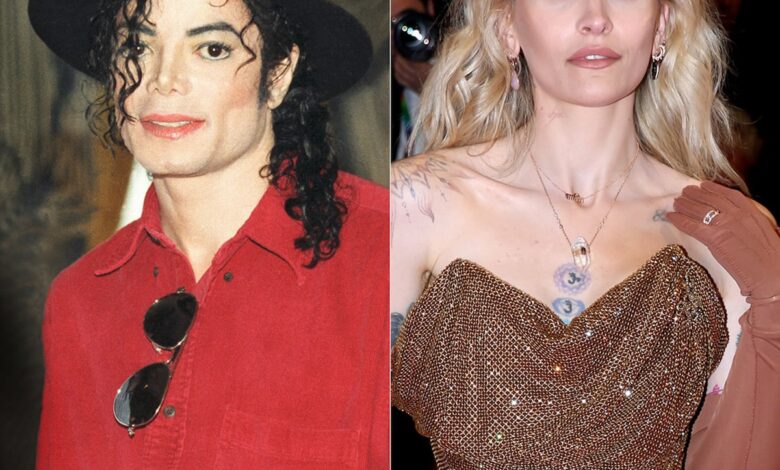
For years, the world knew Paris Jackson only as the veiled child clinging to the hand of the most famous man on Earth. Shrouded in surgical masks and hidden behind the iron gates of Neverland, she was the princess of a kingdom built on both magic and controversy. But today, the masks have been discarded, and the silence has been shattered. In a series of raw, unfiltered revelations, Paris Jackson has stepped forward to claim her own narrative, exposing a life defined by unimaginable trauma, a relentless battle for mental health, and a chilling conviction that her father, Michael Jackson, did not die of natural causes or a simple medical mistake.
The transformation of Paris Jackson from a mourning child to a resilient, outspoken advocate is one of the most harrowing and inspiring stories of modern celebrity. By peeling back the layers of her gilded upbringing, she has revealed a “living archive of survival.” This is no longer the story of a pop star’s daughter; it is the story of a woman who has walked through fire and returned to tell the tale.
The Shadow of the King: A Childhood Under Wraps
Growing up as the daughter of Michael Jackson meant living in a world of extremes. While the public saw the eccentricity—the masks, the private zoos, the constant media circus—Paris describes a childhood rooted in a deep, protective love. However, that protection came at a cost. When her father passed away in 2009, the shield was abruptly removed, leaving an eleven-year-old girl exposed to a world that was often cruel and a grief that was far too heavy for her young shoulders.
The transition from the secluded sanctuary of her father’s care to the harsh reality of the spotlight was jarring. Paris has been candid about the “radical transparency” she now employs, admitting that the years following her father’s death were a descent into darkness. She wasn’t just grieving a parent; she was navigating a global identity crisis while being hounded by the same vultures that her father had spent his life trying to escape.
A Map of Scars: Addiction, Self-Harm, and Survival
Perhaps the most shocking aspect of Paris’s journey is her willingness to discuss the “battlefield of self-hatred” that her body once represented. In her late teens and early twenties, Paris struggled deeply with depression and substance abuse. She has openly discussed her multiple suicide attempts, describing them as a desperate cry for release from a pain that felt terminal.
The scars on her arms, once a source of shame, have been transformed into a “map” of her journey. Paris has covered many of these marks with intricate tattoos—over 50 of them—each representing a moment of reclamation. For her, the ink is not just aesthetic; it is a way to take back control of a body that had been subjected to trauma and self-inflicted harm.
Most devastatingly, Paris revealed that at the age of fourteen, she was the victim of a sexual assault by a complete stranger. This event, occurring while she was already reeling from the loss of her father, acted as a catalyst for much of the self-destructive behavior that followed. By naming this horror publicly, she has broken the cycle of shame, offering a “sanctuary built from truth” for other survivors who feel buried by their own secrets.
The “Forensic” Conviction: Was Michael Jackson Murdered?
While her personal struggles are enough to fill a lifetime, Paris’s most controversial stance involves the death of her father. Despite the official ruling that Michael Jackson died of acute propofol and benzodiazepine intoxication, Paris has remained steadfast in her belief that there is more to the story. She has described her belief that her father was murdered as “forensic” and “obvious.”
She points to the intense pressure her father was under leading up to the “This Is It” tour—a grueling schedule that he allegedly felt he could not survive. Paris recalls him dropping hints that “they” were out to get him, a sentiment echoed by other members of the Jackson family. In her eyes, the King of Pop was a man worth more dead than alive to certain powerful entities, and she views his death not as a tragedy of negligence, but as a calculated hit.
This unwavering loyalty to her father’s memory defines much of her public persona. Even as she navigates her own career in music and modeling, she carries the torch of his legacy, insisting on a narrative that challenges the status quo. She views the industry not as a birthright, but as a “game of chess,” where she must move strategically to protect her father’s name while forging her own path.
Resilience and the Power of Reclamation
Today, Paris Jackson stands at the intersection of grief and resilience. She is no longer the “shielded child” the world remembers. Instead, she is a woman who has looked into the abyss and refused to blink. Her story is a testament to the fact that even the deepest scars can be repurposed into something beautiful.
Her transparency has turned her into an accidental icon for mental health awareness. By being “painfully human,” she has demystified the life of a celebrity scion, showing that money and fame are no armor against the human condition. Her life is a living archive, a collection of stories written in ink and spoken in hushed, steady tones.
Paris Jackson’s journey reminds us that the truth is often more complex than the myths we build around our idols. By exposing her own “legacy of scars,” she has effectively killed the “King of Pop’s daughter” persona to make room for Paris: the artist, the survivor, and the truth-teller. She is no longer playing a part in someone else’s play; she is the author of her own story, insisting on a sanctuary built from the ruins of her past.
In a world obsessed with the downfall of icons, Paris Jackson offers a different ending: a story of survival. Through the fog of suspicion surrounding her father’s death and the clarity of her own recovery, she remains a figure of haunting beauty and terrifying honesty. The mask isn’t just gone—it has been shattered, and what remains is a woman who refuses to be silenced ever again.