
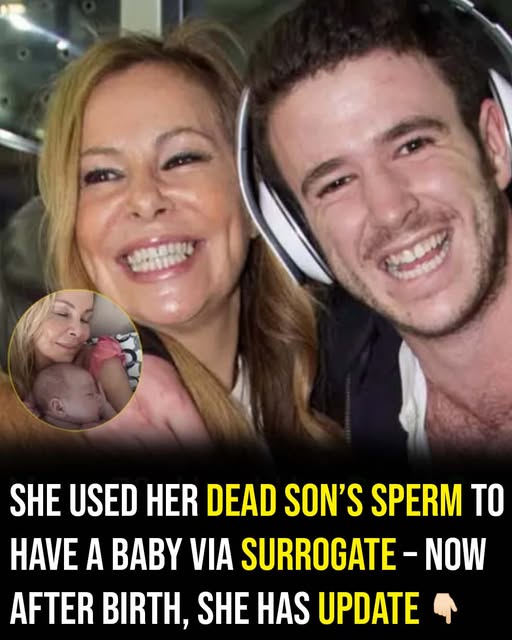
The story of Ana Obregón has stirred strong reactions across Spain and beyond, largely because it sits at the intersection of grief, ethics, and modern reproductive technology.
After losing her only son, Aless Lequio, to cancer in 2022, Obregón faced a kind of loss that is often described as one of the most profound a person can experience. Her decision to move forward with surrogacy using her son’s preserved sperm—ultimately welcoming a baby girl she identifies as her granddaughter—was both deeply personal and publicly debated.
From her perspective, the choice was rooted in honoring what she described as her son’s wish to become a father. In interviews, she has framed the child, Anita, not as a replacement or continuation of her own motherhood, but as a way of preserving her son’s legacy. Her intention to tell the child about her father and who he was reflects a desire to maintain that connection across generations.
At the same time, the broader reaction highlights how complex such decisions can be. Surrogacy laws vary widely across countries, and the fact that the procedure is not permitted in Spain added a legal and ethical dimension to the discussion. Some view her actions as a deeply emotional response to loss, while others question the implications—particularly around consent, timing, and the long-term identity of the child.
There is also the psychological layer. Obregón has openly spoken about the depth of her grief, describing a period in which she felt emotionally absent from life. The arrival of Anita appears to have brought renewed structure and meaning to her daily life, even if it does not erase the loss. Her own words suggest a dual reality: ongoing sorrow alongside a form of healing.
This duality is important. Grief does not follow a fixed path, and people often find different ways to cope or rebuild. For some, that involves memory and reflection; for others, it may involve action—sometimes unconventional or controversial.

Raising a child later in life also introduces practical considerations. Obregón herself has acknowledged the physical challenges, as well as a heightened sense of fear shaped by her past experience. These are not insignificant factors, and they contribute to the broader conversation about responsibility and long-term care.
Ultimately, public opinion tends to split along emotional and ethical lines. Some see the decision as an act of love and resilience—a mother trying to fulfill her son’s dream and keep his presence alive in a tangible way. Others approach it with caution, raising questions about boundaries, societal norms, and the welfare of the child.
What remains clear is that the situation does not lend itself to simple conclusions. It reflects how advances in medicine can intersect with deeply human experiences—loss, memory, identity—in ways that challenge traditional expectations.
In that sense, the story resonates not because it offers easy answers, but because it forces a more nuanced reflection: how far should personal grief shape life-altering decisions, and how does society respond when private choices become public conversations.