
When my sister showed up on my doorstep with two kids, three bags, and nowhere else to go, I thought I understood what I was stepping into.
I thought it would be exhaustion. Extra groceries. Noise. A temporary shift in routine.
I didn’t expect secrets.
She called me at 11:40 p.m. and said, “Can you open the door? Please.”
I was already halfway down the stairs. Something in her voice had pulled me there before my mind caught up.
When I opened the door, she looked… emptied. Not just tired—drained in a way that made her seem smaller than I remembered.
My nephew clutched a plastic dinosaur. My niece stood with one shoe on, one off, like she hadn’t had time to decide.
“What happened?” I asked.
She looked past me, into the house, like she wasn’t sure it was real.
Then she said quietly, “He told us to leave.”
That was enough.
I stepped aside. “Get inside.”
That first night was chaos held together by kindness. Blankets on the couch. Crackers for dinner. Toothbrushes still in plastic. The kids asking if it was a sleepover, and my sister answering yes with a voice that almost didn’t break.
Later, when the house went quiet, we sat at the kitchen table.
“Start talking,” I said.
She stared at her hands. “Caleb lost his job months ago.”
“You told me he picked up extra work.”
“He said he did. He lied.”
Then everything came out—hidden bills, unopened notices, debt she didn’t know existed until that night. A fight. Words said that couldn’t be taken back.
“He opened the door,” she said. “And he didn’t ask us to stay.”
I felt something hard settle in my chest.
“You’re staying here,” I told her.
And she did.
Overnight, my house changed. Mornings had cartoons. The sink filled with tiny cups. Socks appeared in places that made no sense. Sticky fingerprints found every clean surface I owned.
It was messy, loud, and completely necessary.
A few weeks in, she asked if she could use the basement.
“I just want to sort things,” she said. “Make space. Maybe put together donation piles.”
I said yes without thinking.
The basement was separate from the house, with its own entrance. I barely used it. Letting her have that space felt like giving her breathing room.
I thought that was kindness.
Three months passed.
I noticed small things—bags near the basement door, the occasional thud outside—but I didn’t question it. I assumed she was organizing, slowly rebuilding.
Then one morning, just as I was leaving, someone knocked.
It was Mrs. Teresa, my neighbor.
She looked tense.
“You need to check your basement,” she said. “Now.”
Something in her tone made my stomach drop.
“Why?”
She hesitated. “I saw Caleb back there. This morning. Carrying another box.”
The air shifted.
Behind me, the front door flew open.
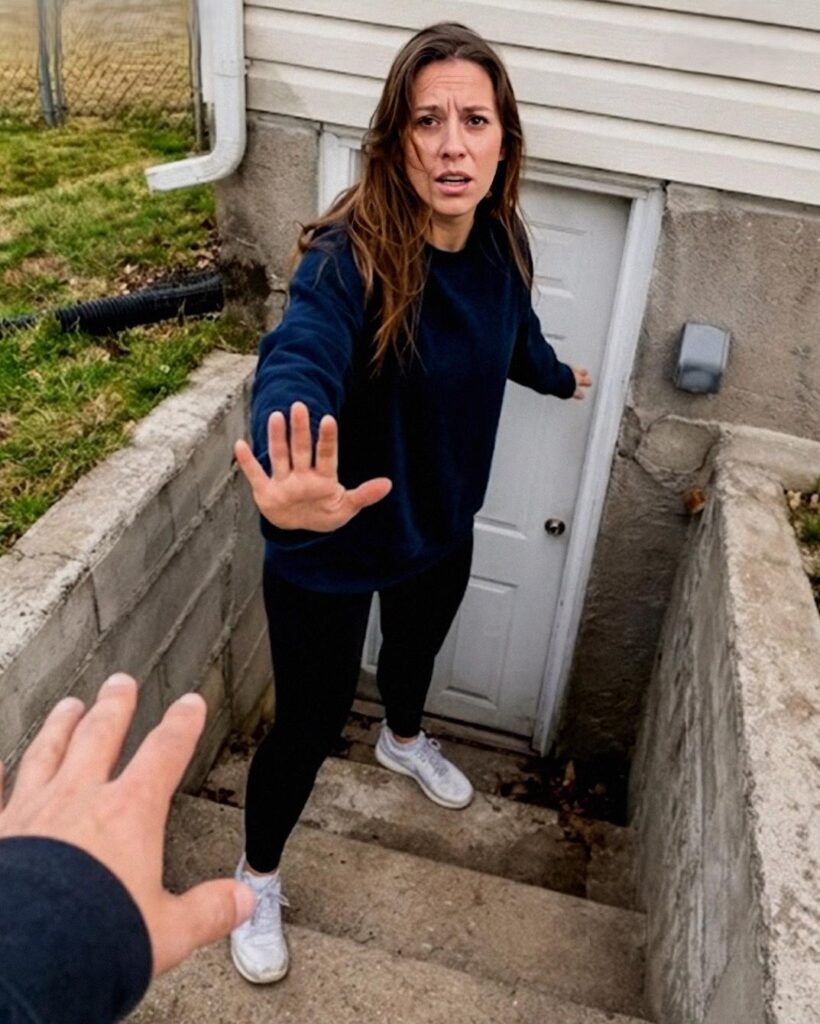
“Wait!”
My sister ran out so fast she nearly stumbled.
“You don’t need to go down there,” she said. “Please. Let me explain.”
That was when I knew.
Whatever was in that basement—she didn’t want me to see it first.
“Move,” I said.
She grabbed my arm. “Please—”
I pulled free.
“How long have you been lying to me?”
I didn’t wait for an answer.
I walked to the side yard, unlocked the basement door, and opened it.
The space didn’t look like storage anymore.
It looked… lived in.
Lamps. A rug. Folding tables covered in tools. Cleaned walls. Repaired steps. Kids’ backpacks in one corner. Stacked furniture wrapped and ready.
And there, standing in the middle of it, was Caleb.
I stared at him.
“Are you kidding me?”
Upstairs, in the kitchen, everything came out.
“I messed up,” Caleb said.
“You destroyed your family and snuck onto my property,” I replied. “Start bigger.”
Family
He admitted everything—losing jobs, hiding the truth, letting things spiral until it broke.
“And the basement?” I asked.
My sister answered this time.
“He came back.”
I looked at her. “What?”
“Two weeks later,” she said. “With a job. With apologies. Wanting to help with the kids. I don’t trust him—but I didn’t know what to do with that.”
“You didn’t think to tell me?”
“I knew what you’d say,” she said. “You’d tell me to cut him off completely.”
“I would.”
“I know.”
She reached into her bag and slid a folder toward me.
Inside was a lease.
Her name only.
Move-in date in two days.
“You’re leaving,” I said.
“Yes.”
“With him?”
“No.”
Caleb shook his head. “Not with me.”
“The apartment is mine,” my sister said. “If he wants to be in our lives, it’s on my terms.”
I looked back at the basement in my mind.
“Then why all of that?”
She exhaled shakily. “We were gathering things. Slowly. Cheap furniture. He fixed the steps. Cleaned. Painted. It just… grew.”
“You turned my basement into a moving operation without telling me.”
Tears spilled down her face. “I was going to tell you.”
“When?”
“I didn’t want to make it harder,” she said. “I already felt like a burden every day.”
That stopped me.
Completely.
Because suddenly, I saw it differently.
Not deception.
Fear.
Not of me—but of needing me too much.
Later that morning, Mrs. Teresa came back—with the kids.
And with the missing piece.
“The apartment is mine,” she said casually, setting a dish on the counter.
I blinked. “What?”
“The one above my garage,” she said. “I offered it to her.”
Everything clicked.
My sister hadn’t been sneaking around to rebuild her life with Caleb.
She had been rebuilding it for herself.
Carefully.
Quietly.
On her own terms.
That night, after the kids were asleep, we sat at the kitchen table again.
“I’m still mad,” I told her.
“You should be,” she said.
The next morning, I helped her pack.
Caleb carried boxes. Mrs. Teresa organized drawers. The kids ran back and forth like they’d been handed something new and exciting.
By sunset, my basement was empty.
Except for one thing.
A small wooden bench.
Our mother’s.
I had forgotten it was even there.
Caleb had repaired it—sanded, stained, steady again.
I sat on it and cried.
Not because everything was fixed.
It wasn’t.
But because something had shifted.
Months later, I visited her apartment.
The kids had their space. There were books, plants, light through the windows. Caleb came by sometimes—but he didn’t stay unless she asked.
She wasn’t going back.
She was moving forward.
When I left, the kids waved from the window.
And my sister stood behind them—not desperate, not uncertain.
Just steady.
Careful.
Hopeful.
Like someone who had finally learned the difference between being saved…
…and standing on her own.