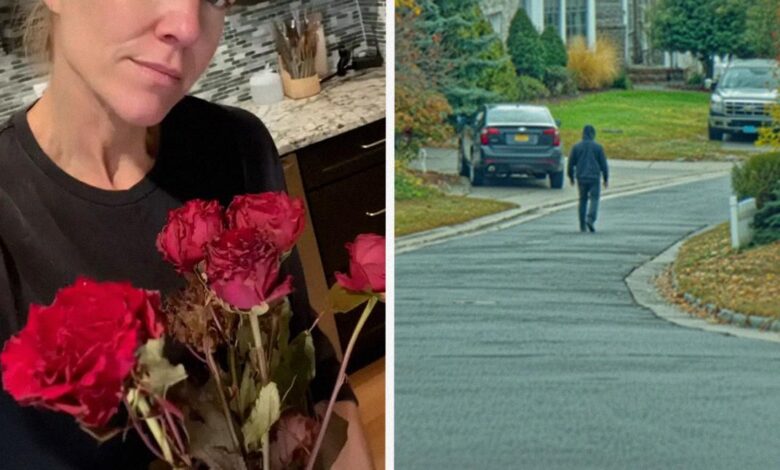
I thought the flowers meant my husband was trying to save our marriage. After sixteen years together, romance didn’t arrive in grand gestures anymore. It came in routines, shared calendars, and quiet teamwork. So when Dan started coming home every Friday with a bouquet, I took it as a sign. A good one.
The first time, it was pink tulips. He kissed my forehead and said, “For you.” Just like that. Simple. Almost shy. I joked that he must have done something wrong, and he laughed it off, saying I deserved flowers for no reason at all. Our kids groaned dramatically from the couch, but I caught myself smiling long after the stems were in water. It felt like a small bridge back to us.
The flowers kept coming. Every Friday. Different colors, different types. Sometimes roses, sometimes lilies, sometimes wild-looking ones that didn’t seem store-bought. I told myself this was what long marriages needed—effort, even if it came late.
But after a few weeks, details stopped lining up.
One bouquet had dirt clinging to the stems, as if they’d been pulled from the ground instead of cut clean. When I asked where he’d bought them, his answer didn’t match what he’d said the week before. First it was a gas station. Then a florist near work. Then a shop across town. Each explanation was casual, tossed out without thought, but they stacked up in my mind like mismatched puzzle pieces.
I tried to ignore the unease. Sixteen years doesn’t disappear because of inconsistent flower stories. Still, something in me tightened.
Then one Friday, while Dan was in the shower, I unwrapped the bouquet and a folded slip of paper fell onto the counter. Four words, written in hurried, childish handwriting: See you next Friday.
My hands went numb.
There was no name. No explanation. Just a sentence that felt like a secret meant for someone else. My chest hollowed out as my mind sprinted ahead of reason. I stood there for a long time, listening to the shower run, staring at that note like it might change if I looked away and back again.
That night, Dan slept easily. I didn’t. I stared at the ceiling, replaying our life together—our wedding, our first apartment, the nights spent rocking babies to sleep, the thousand ordinary moments that built our marriage. I wondered when, exactly, I might have lost him.
All week, I unraveled quietly. I smiled for the kids. I nodded at Dan’s stories. But every late arrival, every buzz of his phone, felt loaded with meaning. By Friday morning, I was exhausted from holding it all in.
So I followed him.
I told work I was sick, sent the kids to school, and parked across from his office. I waited. Hours passed. Then, three hours before his shift normally ended, Dan walked out and got into his car. No calls. No hesitation.
I followed at a distance, my heart pounding so hard it hurt.
He drove across town and into a neighborhood I recognized instantly. My stomach dropped when he pulled into a driveway on a street I knew too well.
Erika’s street.
Erika was a name from our past. A loud, messy one. She’d been close to Dan once—too close. She’d stood up at our wedding and announced she loved him. She’d tried to kiss him after the reception. Dan had sworn she was gone from his life forever.
Now he was walking into her house.
I parked down the block, shaking, then marched to the door before I could talk myself out of it. An older woman answered. She looked surprised but calm.
“My husband just came in here,” I said, my voice breaking. “I need to know what’s going on.”
She studied my face for a second, then softened. “He’s not cheating on you,” she said gently. “Please come in.”
The house smelled like soup and lavender. Family photos lined the walls. She led me into the living room, where a hospital bed sat near a window.
Dan was sitting beside it, reading aloud.
And in the bed was Erika.
Not the Erika I remembered. This woman was pale and thin, her hair cut unevenly, her expression soft and distant. She held a stuffed bear and smiled faintly at nothing in particular.
Dan looked up and went still when he saw me.
“She was in a car accident,” the older woman said quietly. “Fourteen months ago. Severe brain injury. She doesn’t remember most of her life. Mentally, she’s about ten years old. But she remembers Dan. He was her safe person growing up.”
The room tilted.
Dan stood. “I didn’t tell you because of our history,” he said. “I was afraid you’d think the worst.”
I believed him. Too late, but completely.
The flowers made sense then. The dirt on the stems came from the garden. The note wasn’t a secret message—it was a reminder from her mother. A mistake. A misunderstanding that nearly tore my marriage apart.
Erika looked at me and smiled. “You’re pretty,” she said.
I took her hand and nodded, swallowing past the lump in my throat.
Now, Dan still visits her. Sometimes I go too. We bring cookies. We read. We sit. The flowers still arrive every Friday.
They’re not symbols of betrayal.
They’re proof that love doesn’t always look the way we expect it to. Sometimes it’s quiet. Sometimes it’s messy. Sometimes it comes with dirt on the stems and no explanation at all.