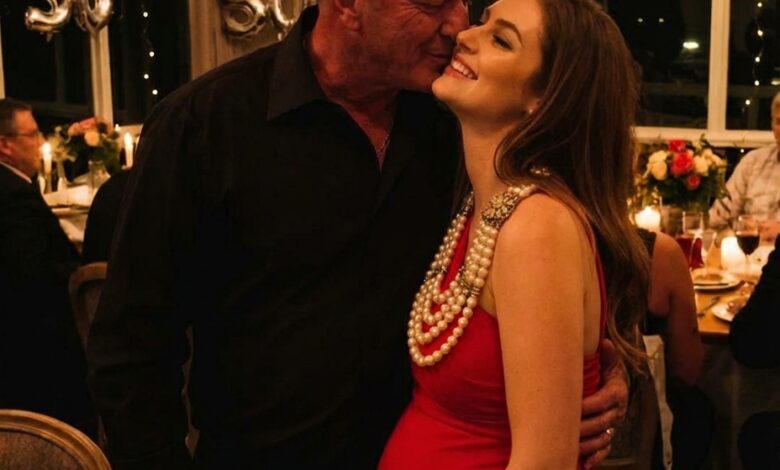
The golden ballroom of the Grand Excelsior was a masterpiece of orchestrated joy, dripping in silk draperies and the scent of five hundred imported white lilies. It was my fiftieth birthday—the “Golden Jubilee,” as my husband, Julian, had taken to calling it during his toast. To the two hundred guests watching us from beneath the crystal chandeliers, we were the blueprint of a successful life. We had the thriving architectural firm, the three beautiful children who were now young adults with their own burgeoning ambitions, and a marriage that had survived three decades of high-stakes pressure. I stood on the small mahogany stage, the candlelight catching the sequins of my gown, and smiled. It was a practiced smile, one that didn’t quite reach the hollow ache in my chest that had been growing for nearly a year.
I had spent months ignoring the signs. The late nights at the office that didn’t result in new blueprints, the scent of a perfume that wasn’t mine lingering in the foyer, and the way Julian’s eyes seemed to slide past mine whenever we sat down for dinner. I had convinced myself that fifty would be the reset. I thought that by throwing this lavish party, by surrounding ourselves with the people who saw us as a pillar of the community, I could shame the shadows back into the corners. I wanted to believe that if I performed the role of the beloved wife perfectly enough, the reality would follow suit.
The band had just finished a soulful rendition of a classic jazz standard when the heavy oak doors at the back of the ballroom creaked open. At first, I thought it was a late arrival, perhaps one of Julian’s overseas clients. But as the silhouette moved into the light, the room began to fall into a strange, rhythmic silence. It started at the back tables and rolled forward like a cold tide.
She was young, perhaps twenty-four, wearing a cocktail dress that was far too understated for a black-tie gala but far too expensive for a casual night out. She didn’t look like a crasher; she looked like someone who belonged exactly where she was standing. But it wasn’t her youth or her defiant posture that stopped my heart. It was the weight around her neck.
Glistening against her collarbone was a vintage Cartier necklace—an intricate web of diamonds and emeralds that had belonged to my grandmother. It had gone missing from my jewelry box three months ago. I had torn the house apart looking for it, eventually filing an insurance claim and weeping over the loss of the only piece of my heritage I truly cherished. Julian had held me while I cried, whispering that it was just an object and that he would buy me something ten times more valuable for my birthday.
Now, that “missing” heirloom was draped around the neck of a stranger who was staring directly at my husband.
The silence in the room became absolute. I could hear the faint hum of the air conditioning and the frantic, uneven thud of my own pulse. My children, seated at the front table, looked from me to the woman and then to their father. Julian’s face, usually so composed and tan, turned a sickly shade of grey. He didn’t move. He didn’t breathe. The glass of vintage champagne in his hand trembled so violently that the liquid spilled over the rim, staining his white cuff.
The woman didn’t cause a scene. She didn’t scream or point fingers. She simply walked toward the stage with a slow, deliberate grace, her eyes never leaving Julian’s. The audacity of her presence was more crushing than any verbal confession could have been. She was the physical manifestation of every doubt I had suppressed, every lie I had swallowed to keep my world from tilting.
As she reached the foot of the stage, she stopped. She reached up, her fingers grazing the emeralds that should have been mine, and smiled—not at me, but at the man standing three feet to my left. It was a smile of possession.
I felt a wave of nausea so intense I thought I might collapse. My dignity was being stripped away in front of everyone I knew—the board members, our neighbors, our children’s teachers. The “Golden Jubilee” had become a public execution of my pride.
Suddenly, a chair scraped against the marble floor. My mother-in-law, Eleanor, stood up. At eighty-two, she was still the most formidable person in any room, a woman who valued lineage and integrity above all else. She didn’t look at the young woman, and she didn’t look at her son. She walked up the stairs of the stage and stood between me and Julian.
Eleanor didn’t need a microphone. Her voice, though low, carried to every corner of the ballroom. She looked out at the guests, her spine as straight as a spear. “True wealth,” she began, her tone clipping the air, “is not found in the stones we wear or the parties we throw. It is found in the promises we keep. When a man forgets the value of his own house, he loses the right to stand at the head of it.”
She turned slowly to the young woman at the base of the stage. “You are wearing a piece of history that does not belong to you, given to you by a man who had no right to give it. You may keep the necklace for tonight, as a reminder of exactly what kind of man you have aligned yourself with. But by tomorrow morning, my lawyers will ensure that every stolen item is returned to its rightful owner.”
Then, Eleanor turned to Julian. She didn’t yell. She simply looked at him with a profound, icy disappointment that seemed to age him twenty years in an instant. “Leave this room, Julian. You are no longer the host of this celebration. You are merely a guest who has overstayed his welcome.”
The room remained hushed as Julian, broken and exposed, turned and walked toward the side exit. He didn’t look back. The young woman, realizing the tide had turned from curiosity to collective disdain, vanished back through the oak doors, the stolen diamonds flickering one last time before she disappeared into the night.
I stood there, my hands shaking, feeling the eyes of two hundred people on me. I expected to feel shame, but as I looked down at my children—their faces a mix of shock and fierce protection—a different emotion took hold. It was a cold, crystalline clarity. The life I had been trying so hard to save was already dead. It had been dead for a long time, and I had been acting as its mourner rather than its survivor.
I stepped toward the microphone. My voice was thin at first, but it grew stronger with every word.
“Tonight was supposed to be a celebration of fifty years,” I said, looking out at the faces of my friends. “But I realize now that the number isn’t a milestone of the past. It’s a starting line for the future. I want to thank you all for being here to witness the beginning of my next chapter.”
I signaled to the bandleader. “Please, play something with a bit more life. My children and I would like to dance.”
The rest of the night was a blur of motion. I didn’t hide in the bathroom, and I didn’t cancel the catering. I spent the evening surrounded by my daughters and my son, dancing until my feet ached and the sun began to peek through the high windows of the ballroom. People approached me with hushed apologies, but I waved them away. I didn’t want their pity; I had finally found something much more valuable.
As I walked out of the hotel the next morning, the air was crisp and biting, smelling of rain and asphalt. I wasn’t wearing my grandmother’s necklace, and I wasn’t carrying the weight of a dying marriage. I realized then that dignity wasn’t something Julian could take from me, nor was it something Eleanor could give back. It was the quiet, steady choice to walk away from a burning building without looking back at the ornaments left inside. I was fifty years old, and for the first time in my life, I knew exactly who I was when no one was watching. The party was over, but the light was just beginning to change.